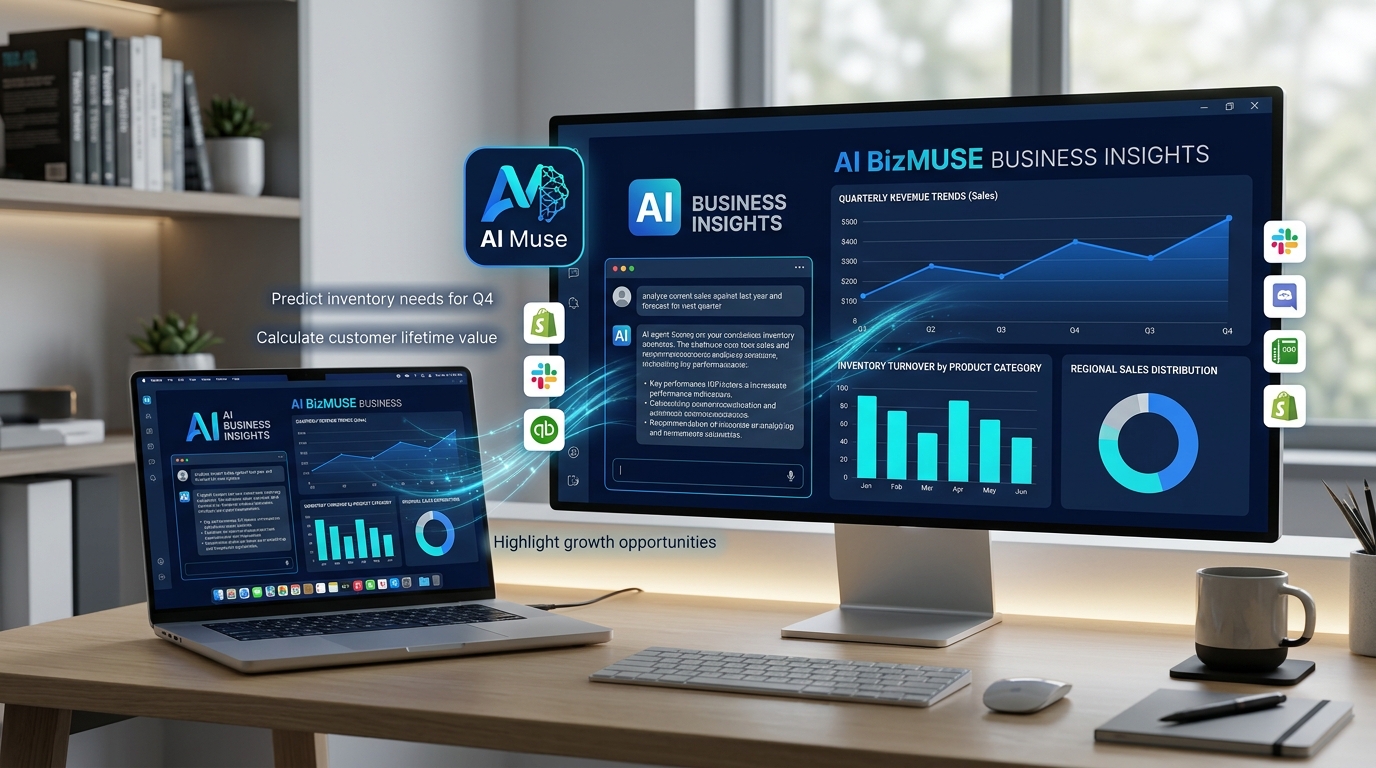
In late 2026 the AI agent trend finally hit small businesses. Meta (Facebook) introduced Muse for Small Business, an AI assistant that can connect to your business accounts (Shopify, Stripe, QuickBooks, Slack, etc.) and answer questions about sales, inventory, or marketing campaigns. At the same time, industry reports note that more small businesses are “stepping up their AI usage” by connecting chatbots to their own data (using standards like the Model Context Protocol, MCP) for natural-language reporting. These developments mean small business owners can now ask an AI agent to analyze sales or manage workflows without manual lookups.
What Are AI Agents (and Muse)?
An AI agent is a system that can take multi-step actions on your behalf by using tools or APIs under the hood. Unlike a simple chatbot, an agent can plan a sequence of tasks across multiple systems. For example, Meta’s Muse can be given a goal like “analyze last month’s sales and suggest marketing ideas.” It will then pull data from your e-commerce and advertising accounts and generate a report. Muse does this by using pre-built “connectors” to popular business software: in a few clicks it can read from Shopify, Slack, QuickBooks and hundreds of others. Once connected, it already “understands your business” – what you sell, your brand voice, and customer questions – so it can hit the ground running.
Behind the scenes is the Model Context Protocol (MCP), an open standard (originally by Anthropic) for linking AI agents to data systems. MCP has been adopted by OpenAI, Google, IBM and others, and the 2026-07-28 update made it stateless and easy to host on any server. In practice, this means any small business can expose its CRM, ERP or inventory database through a single MCP connector and allow different AI assistants to access it. The Forbes Small Business report explains it like “MCP acts like ODBC” for AI: it provides a common bridge between chatbots and apps like your accounting or CRM software. In short, MCP turns your data into a queryable knowledge base for AI.
How Small Businesses Are Using AI Agents Today
Many use cases are emerging. For example, an AI agent can qualify leads: a website chatbot asks incoming prospects key questions (budget, timeline, needs), saves the answers, and even books meetings if criteria are met. Another is customer support: the agent can automatically sort and route messages (billing, quotes, returns) and write draft replies. It can process documents: scanning invoices or purchase orders and entering them into your accounting system without retyping. Most importantly, AI agents handle routine queries. Trained on your policies and data, they can answer 80–90% of routine customer and employee questions instantly, freeing staff for higher-value work. The Forbes article notes small businesses are already using chatbots to ask natural questions like “Which products haven’t sold in 6 months?” or “Who are our most profitable customers?” by hooking chatbots to their sales database. With a true agent, you could even say: “Make a growth plan for next year using current sales and campaign data,” and get a draft proposal back (see Muse example use cases).
Off-the-Shelf vs Custom: What Fits Your Business?
You have two main options: use an existing AI agent platform, or build a custom solution with Lishaq. **Off-the-shelf agents** (like Meta’s Muse, Microsoft Copilot for business, or OpenAI’s enterprise services) let you “plug and play.” They come with connectors for popular tools and handle security behind the scenes. For instance, Muse can instantly read from Facebook ads, Shopify orders, and email, so you can start asking high-level questions right away. This is fast to deploy and often low-cost (Muse is free with certain accounts), but you’re tied to the agent’s capabilities and pricing model. You must trust its data handling and can’t customize workflows deeply.
**Custom AI integrations** give full control. Lishaq Solutions can develop a tailored agent or chatbot that uses your specific systems and rules. For example, we can build a private chatbot that connects to your bespoke inventory database and internal dashboards. You could host it on your own server or a secure cloud. This avoids vendor lock-in and allows fine-tuning: the bot only knows approved information (so it won’t reveal sensitive data) and follows your business logic exactly. However, custom development takes more time and investment. It’s wise when off-the-shelf tools fall short: if you have niche processes, strict compliance needs, or want unique features not in a public product, a custom solution is justified.
Key Considerations and Next Steps
- Data Access and Permissions: Only expose data the agent really needs. Grant it read access to relevant accounts (sales, inventory, support tickets) and enforce strong authentication. For example, never let an agent modify bank transactions on its own.
- Human Oversight: Always keep humans in the loop for high-stakes decisions. Let the agent draft invoices or marketing drafts, but have a person approve them. Design your agent so it flags requests it’s uncertain about, rather than guessing.
- Security and Privacy: Use secure connectors (like OAuth for APIs) and audit logs to track AI queries. Verify that any external AI service complies with privacy standards. (For instance, Meta promises Muse won’t share your conversations for ads, but you should confirm such policies for any provider.)
- Start Small: Pick one clear task to automate first (e.g. lead qualification or report generation). Measure the benefits (time saved, faster responses) and refine before expanding to other processes. The Forbes report suggests using AI “for natural language reporting” on key metrics as a great first step.
- Measure ROI: Track how much time or money the agent saves. If you cut even half of a few administrative hours per week, the agent pays for itself quickly. Plan your project by weighing the development cost against these savings.
How Lishaq Solutions Can Help: Lishaq has built custom chatbots, AI integrations, and dashboards for clients. We can assess your tools (e.g. e-commerce, accounting, POS) and help decide whether an off-the-shelf agent or a custom integration makes sense. We handle the technical heavy lifting: setting up connectors (MCP or APIs), ensuring security, and training the AI on your data. For example, we could develop a custom AI agent that uses your Laravel backend and database to answer business questions exactly the way you want. Discuss your project with us and we’ll outline a plan tailored to your business.
Further Reading
- Meta Newsroom – Introducing Muse for Small Business (Official announcement of Muse and its connectors.)
- Model Context Protocol Blog – 2026-07-28 MCP Release Candidate (Details of the new stateless MCP standard for AI integration.)
- Forbes – Some Businesses Stepped Up AI in 2026... (Small business AI chatbot trend overview.)