Your online store receives an order. Your team packs the product, books a courier, prints the shipping label and dispatches the parcel. A few days later, the courier brings it back because the customer refused delivery, could not be contacted or provided an incomplete address.
You have lost more than a sale. Depending on your courier agreement, you may have paid delivery or return charges, used packaging, spent staff time and temporarily lost access to stock that could have been sold to another customer.
This is called Return to Origin (RTO). It is one of the operational problems Pakistani e-commerce sellers need to manage when accepting Cash on Delivery (COD) orders.
In an article published on 30 July 2026, DHL Pakistan reported an estimated COD RTO rate of around 18% to 20% for e-commerce shipments in Pakistan — approximately one parcel in five. This is an industry-reported benchmark, not a guaranteed rate for every store. Your actual result can vary by product category, city, customer experience and courier service. You can read the DHL Pakistan guide to reducing COD returns.
The solution is not necessarily to remove COD. It is to build a better process for verifying orders, preparing shipments, communicating with customers, monitoring couriers and handling returned stock. This guide explains how to do that — and how the right e-commerce software can make the process easier to manage.
1. What Is RTO in E-commerce?
Return to Origin, commonly called RTO, happens when a shipment cannot be delivered to the customer and is returned to the seller or its dispatch location.
For a COD order, common reasons include:
- The customer refuses to accept the parcel.
- The customer cannot be reached by the courier.
- The delivery address is incomplete or incorrect.
- The customer cancels after the order has been dispatched.
- The customer is unavailable during delivery attempts.
- The courier cannot complete delivery because of a service or operational issue.
It is important to distinguish RTO from a normal customer return. RTO generally means the parcel was not successfully delivered in the first place. A customer return usually happens after the customer has received the product and then requests to return or exchange it.
These two processes should have separate records in your store because their costs, reasons and inventory workflows are different.
2. Why COD Returns Are a Serious Problem for Pakistani Online Stores
Cash on Delivery remains important for many Pakistani customers. A survey release published by Gallup & Gilani Pakistan on 19 December 2025 reported that 60% of surveyed online purchasers had used COD when shopping online during the previous six months. This is one reason stores should think carefully before removing COD completely.
Read the Gallup & Gilani survey release for its original findings and context.
However, offering COD without managing the fulfilment process can expose a store to several problems.
Repeated courier expenses
When an undelivered parcel returns to your warehouse, the courier charges depend on the agreement and service used. Some arrangements may involve an outbound delivery charge, a return charge or other applicable fees. Check your actual courier contract rather than assuming every shipment has the same cost.
Stock becomes unavailable
A product travelling between your warehouse and a customer cannot normally be sold to another buyer during that period. When it returns, your team may need to inspect it, check its packaging and decide whether it can be returned to sellable stock.
Staff spend time on repetitive work
Employees may need to call customers, contact couriers, check tracking pages, update order statuses, receive returned parcels and correct stock records. When these steps happen in separate spreadsheets or messaging conversations, it becomes difficult to see the complete history of an order.
Cash-flow visibility becomes weaker
Delivered COD orders still need to be reconciled against the money collected and transferred by the courier. If your team does not track delivered shipments, expected remittances and actual settlements, it becomes harder to identify delayed or missing payments.
3. Calculate Your Actual COD Return Rate
Before changing your process, calculate your current RTO rate. Without a baseline, you will not know whether your improvements are working.
Use this formula:
COD RTO Rate (%) = (COD parcels returned undelivered ÷ COD parcels handed over to the courier) × 100
For example, suppose your online store dispatches 420 COD parcels during one month. The courier eventually returns 84 of those parcels without successful delivery.
| Metric | Example |
|---|---|
| COD parcels dispatched | 420 |
| Parcels returned undelivered | 84 |
| Successfully delivered parcels | 336 |
| Calculated RTO rate | 20% |
This is an illustrative calculation, not a reported store result or a national benchmark.
Measure RTO against parcels actually handed over to the courier, not every order placed on your website. Cancelled orders that never entered the courier network should be recorded separately.
4. Calculate How Much Failed COD Deliveries Cost Your Business
Many store owners count only the courier bill when a parcel returns. The actual operational cost can be broader.
Consider these cost components:
- Non-refundable outbound shipping charges, where applicable.
- Return shipping charges under your courier agreement.
- Packaging materials and handling time.
- Staff time spent contacting customers and tracking shipments.
- Products damaged or made unsellable during transit.
- Sales opportunities lost while stock is unavailable.
A useful calculation is:
Estimated direct RTO cost = Returned parcels × (applicable outbound charge + applicable return charge + packaging and handling cost) + other documented losses.
For a more realistic estimate, keep damaged or unsellable stock separate from ordinary returned stock. A returned product that passes inspection may still be sold again, while a damaged product may create an additional loss.
Also avoid counting the same expense twice. For example, do not add a handling cost separately if it is already included in an internal per-parcel cost figure.
5. Eight Practical Ways to Reduce COD Returns
There is no single trick that prevents every failed delivery. The strongest approach is to address the reasons behind your own returned parcels and improve the steps that happen before and after dispatch.
1. Collect complete delivery information at checkout
An order with an incomplete address creates avoidable delivery problems. Your checkout should collect the information your courier actually needs.
Depending on the delivery area, useful fields can include:
- Customer name and reachable phone number.
- City and delivery area.
- Street, house or building details.
- A nearby landmark when needed.
- A separate delivery note for useful instructions.
Do not make checkout unnecessarily complicated. Ask only for information that supports fulfilment, use clear labels and validate required fields before accepting the order.
2. Verify orders before creating courier bookings
For COD orders, a short confirmation step can help identify customers who placed an order by mistake or entered incorrect delivery information.
Depending on your business, you can use a confirmation call, SMS verification or a permitted messaging workflow. Keep the process simple: confirm the product, quantity, delivery address and customer's intention to receive the parcel.
For higher-value or incomplete orders, your team may choose to perform an additional manual check before dispatch. Do not automatically reject every new customer or every order that looks unusual. Use the review process to ask for clarification, not to make unfair assumptions.
3. Make product information clear and accurate
Some customers refuse parcels because what arrives does not match what they expected from the product page.
Improve product listings by providing:
- Clear, original product photographs from useful angles.
- Accurate sizes, dimensions, colours and material details.
- Correct prices and available variants.
- What is included in the package.
- Realistic shipping timelines and delivery conditions.
- A clear return and exchange policy.
For clothing, show useful size information. For electronics, mention compatibility and included accessories. For household products, provide dimensions and material details. Better expectations can reduce avoidable misunderstandings.
4. Dispatch confirmed orders without unnecessary delays
A customer who places an order today may lose interest if the store takes several days to process it without an update.
Create a clear dispatch workflow. Separate new orders from confirmed, packed and ready-to-ship orders. Assign responsibility for pending orders and investigate orders that remain in the same status for too long.
Track the time between order placement, confirmation, packing and courier handover. This helps identify delays inside your own business before blaming the delivery company.
5. Give customers useful delivery updates
After dispatch, customers should be able to understand what is happening to their parcel.
Useful updates include:
- Order confirmed.
- Parcel dispatched.
- Courier tracking reference available.
- Delivery attempt or rescheduling information, where supplied by the courier.
- Successful delivery or return status.
Updates should be based on actual order or courier events. Avoid sending a message that says a parcel is out for delivery when the courier has not reported that status.
6. Keep COD while making prepaid payment attractive
Completely removing COD may make checkout less accessible to customers who prefer to pay when receiving their order. Instead, consider offering a genuine alternative for customers who are comfortable paying digitally.
Depending on your payment provider and business setup, you could offer a small prepaid discount, loyalty points or a clearly explained delivery incentive. Make sure the offer is financially sustainable and that the checkout does not mislead customers about fees or payment terms.
For Pakistani merchants, the State Bank of Pakistan explains that businesses can enable Raast payment acceptance through their respective banks or payment service providers. You can read its official guidance for joining Raast.
A suitable payment option should be selected according to your customers, provider availability, settlement process and integration requirements.
7. Compare courier performance using actual records
Do not select a courier only because its advertised delivery price is lower. Your business needs to understand what happens after the parcel leaves the warehouse.
Compare available couriers using operational measures such as:
- Delivery success by city and destination area.
- First-attempt delivery performance.
- Reasons for unsuccessful delivery.
- Tracking update quality and frequency.
- Return charges and reverse-logistics process.
- COD remittance timing and settlement records.
- Customer support and complaint handling.
A courier that performs well for one product category or city may not perform equally well for another. Review your own shipment history before making large changes.
8. Inspect returned parcels and update inventory properly
A returned parcel should not automatically become available stock. First, record its arrival and inspect the product and packaging.
Use a simple receiving process:
- Match the returned parcel with its original order and courier reference.
- Record the return date and reason supplied by the courier.
- Inspect the product and its packaging.
- Mark it as sellable, damaged, incomplete or awaiting inspection.
- Update inventory only after its condition is confirmed.
- Record any additional expense or follow-up required.
This prevents a damaged or incomplete item from accidentally being sold to another customer.
6. How an Order Management System Can Control the COD Workflow
Calls, spreadsheets and separate courier portals may be manageable when a store has very few orders. As order volume and staff responsibilities grow, manual updates become harder to coordinate.
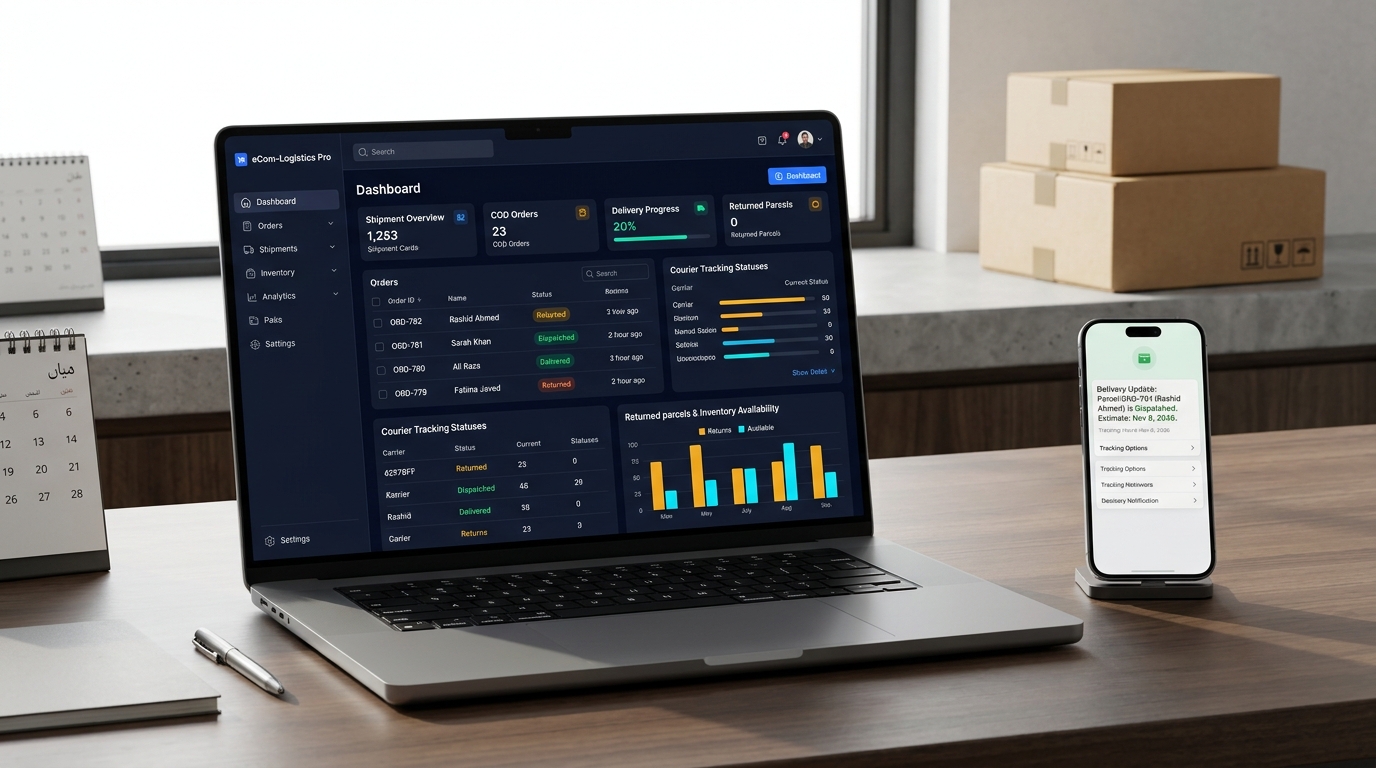
An order management system can bring the important parts of the process into one place. Instead of checking several platforms to understand what happened to an order, your team can view its current status and history from a central dashboard.
Example order workflow
| Stage | System status | What the team does |
|---|---|---|
| Customer places order | New | Save customer, product and delivery details. |
| Details checked | Pending Confirmation | Verify customer intent and delivery information. |
| Order approved | Confirmed | Reserve stock and prepare the order. |
| Courier receives parcel | Dispatched | Save courier, booking reference and tracking number. |
| Courier is delivering | In Transit / Out for Delivery | Review courier updates and handle exceptions. |
| Delivery succeeds | Delivered | Record delivery and reconcile expected COD payment. |
| Delivery fails and parcel returns | RTO / Returned to Warehouse | Receive, inspect and process the returned stock. |
These are example internal statuses. Courier companies may use different status names, so an integration should map the courier's actual responses to your own order workflow while preserving the original tracking information.
Features worth considering
- Central order dashboard: View new, confirmed, dispatched, delivered and returned orders.
- Order verification records: Store confirmation status, date and relevant notes.
- Courier booking: Connect supported courier services when their APIs and account permissions are available.
- Tracking synchronization: Record available shipment events without relying entirely on manual updates.
- RTO reason tracking: Record whether a shipment was refused, unreachable, incorrectly addressed or returned for another reason.
- Inventory synchronization: Update stock after the returned product has been inspected.
- COD reconciliation: Compare delivered COD orders with courier settlement records.
- Reports: Compare RTO rates by courier, city, product, sales channel and period.
- Role-based access: Let sales, warehouse and operations staff handle their assigned responsibilities.
Not every courier offers the same API access, events or integration options. Confirm the courier's current documentation, account requirements and commercial terms before planning an automated connection.
7. The Five Metrics Every E-commerce Owner Should Monitor
A dashboard should help you discover where the problem is happening, not just show the total number of orders.
1. COD confirmation rate
Measure confirmed COD orders against COD orders that entered your confirmation process. This helps you see how many orders remain unconfirmed or are cancelled before dispatch.
2. RTO rate
Measure returned undelivered COD parcels against COD parcels handed to the courier. Review the reasons and compare the rate over consistent reporting periods.
3. First-attempt delivery success
Track how many shipments are delivered on the first delivery attempt. This can help you identify address-quality problems, customer availability issues or courier performance differences.
4. Return-to-stock time
Measure how long a returned parcel takes to arrive at the warehouse, pass inspection and become available for sale again. A returned product sitting unprocessed for several days may create another operational bottleneck.
5. COD settlement ageing
Track how much money is expected from delivered COD shipments and how long it takes to reconcile actual courier settlements. This is particularly useful when dealing with multiple couriers.
Segment these metrics by courier, destination, product category and sales channel. An overall average can hide a problem that affects only one part of your operation.
8. Do You Need Custom E-commerce Software or Is a Spreadsheet Enough?
Every business does not need a custom system. Choosing the right solution depends on your order volume, number of sales channels, courier arrangements and how much manual work your team performs.
| Your situation | Practical starting point |
|---|---|
| You receive a small number of orders and one person manages fulfilment. | A structured spreadsheet and the courier's standard tracking tools may be sufficient. |
| Your team handles orders from a website, social media and marketplaces. | Consider a centralized order management process. |
| You work with several couriers and repeatedly copy order details. | Evaluate supported courier integrations and a unified dashboard. |
| Returned parcels cause stock discrepancies and reporting problems. | Consider connecting order management with inventory tracking. |
| You need specific business rules, reports or integrations that ready-made tools cannot handle. | Consider a custom business application built around your workflow. |
The important decision is not whether custom software is more advanced. It is whether the time, errors and limitations of your current process justify a different system.
9. How Lishaq Solutions Can Help Your E-commerce Business
When order management, inventory and courier operations are spread across different tools, a business can struggle to see what is happening from checkout to delivery.
Lishaq Solutions builds custom e-commerce websites and business applications for companies that need more control over their online operations.
Depending on your requirements and the available third-party APIs, we can help plan and develop solutions such as:
- Custom e-commerce websites with structured order management.
- COD confirmation and order-processing workflows.
- Inventory management connected to online orders.
- Admin dashboards for order, courier and operational reporting.
- Third-party API integrations where the provider supports the required access.
- Custom Laravel applications for business-specific workflows.
Explore our e-commerce website development, inventory management systems, admin dashboards and Laravel development services.
We do not promise that software alone can eliminate RTO. Customer decisions, product quality, courier operations and delivery conditions all matter. The right system can, however, help your team organize information, identify recurring problems and manage the process more consistently.
Planning to improve your store's order and delivery workflow? Contact Lishaq Solutions and tell us which e-commerce platform you use, how you manage COD orders and which courier or inventory problems you face. We can discuss whether an existing tool, an integration or a custom system is the most practical option.
Frequently Asked Questions
What does RTO mean in e-commerce?
RTO means Return to Origin. It usually refers to a parcel that could not be delivered to the customer and is returned to the seller or dispatch location. It is different from a customer returning a product after successful delivery.
What is the COD RTO rate in Pakistan?
DHL Pakistan reported an estimated e-commerce COD RTO range of approximately 18% to 20% in its guide published on 30 July 2026. This should be treated as an industry-reported benchmark, not an exact figure for every store, courier or product category.
How can I reduce COD returns for my online store?
Start by collecting complete delivery details, verifying customer intent before dispatch, describing products accurately, dispatching confirmed orders promptly, sharing useful tracking updates and reviewing failed-delivery reasons. Measure your own RTO rate before and after making changes.
Should I stop offering Cash on Delivery?
Not necessarily. COD remains important to many Pakistani online shoppers. Consider keeping it available while offering trustworthy prepaid alternatives, improving product information and confirming orders before shipment.
Can courier APIs be connected to a custom e-commerce website?
Yes, where the courier provides the necessary API access and your business meets its account requirements. Depending on the available integration, your website may be able to create bookings, retrieve tracking information and update shipment events. Confirm the current technical documentation with the courier.
Can a Laravel system manage COD orders and returned stock?
A Laravel application can be designed to manage order verification, dispatch records, courier references, shipment statuses, RTO processing and inventory updates. The exact features depend on your business workflow and any third-party services involved.
How should I calculate my store's RTO rate?
Divide COD parcels returned undelivered by COD parcels handed over to the courier, then multiply by 100. Keep cancelled orders that never reached the courier separate from RTO shipments.
Does an order management system guarantee fewer returns?
No. Software cannot guarantee that customers will accept deliveries or that couriers will successfully reach every address. It can help reduce avoidable process errors, organize follow-ups and reveal the reasons behind failed deliveries so that your business can make better decisions.